

The sewing machine has been a cornerstone of textile manufacturing for over 170 years. Its basic mechanism — a needle driving thread through fabric layers to create a lockstitch — has been refined but never fundamentally replaced. Yet in specific segments of garment and non-woven product manufacturing, a different technology is gaining ground: ultrasonic sewing, which bonds materials without thread, without needles, and without the limitations inherent in mechanical stitching.
This Changpu ultrasonic sewing machine vs traditional sewing comparison examines the two technologies across the dimensions that matter most to B2B buyers: production speed, operating cost, seam quality, material compatibility, and application suitability. As an ultrasonic underwear sewing equipment manufacturer China, Jiangsu Changpu Intelligent Technology has direct experience with the real-world performance differences that manufacturers encounter when transitioning from traditional to ultrasonic methods.

How the Technologies Work
Traditional Sewing: A motor-driven needle carries thread through the fabric layers, where it interloops with thread from a bobbin to create a locked stitch. The process is mechanical, well-understood, and highly developed. Modern industrial sewing machines operate at speeds up to 5,000 stitches per minute, and the technology works with virtually any fabric type — woven, knitted, non-woven, natural fiber, synthetic, or blended.
Ultrasonic Sewing: High-frequency mechanical vibration (typically 20 kHz or 35 kHz) is applied to thermoplastic fabric layers through a vibrating horn. The vibration creates molecular friction at the material interface, generating localized heat that melts and fuses the thermoplastic fibers. No thread, no needle, and no external heat source are involved. The result is a bonded seam created by the material itself, not by a separate thread passing through it.
The fundamental difference is conceptual: traditional sewing is a mechanical fastening process — a thread physically holds layers together — while ultrasonic sewing is a welding process — the material layers become one continuous piece at the bond point.
Head-to-Head Comparison
Production Speed — Ultrasonic sewing is inherently faster than traditional stitching for continuous seam applications. A Changpu ultrasonic sewing machine can process material at line speeds limited only by the material feed rate and the ultrasonic cycle time — typically 10 to 50 meters per minute depending on material thickness and bond pattern. Traditional sewing machines are limited by stitch rate (maximum ~5,000 stitches per minute), which translates to roughly 5 to 15 meters per minute for typical stitch densities. For high-volume production of items like surgical gowns, disposable underwear, and non-woven bags, the speed advantage of ultrasonic sewing is substantial.
Consumable Cost — This is one of the most significant operational differences. Traditional sewing consumes thread — a recurring cost that, for high-volume manufacturers, can represent a substantial annual expense. Thread also requires inventory: different types, colors, and qualities must be sourced, stored, and managed. Thread breakage causes production stoppages. Bobbin changes interrupt workflow. Ultrasonic sewing eliminates all of these — no thread to purchase, no thread to break, no bobbin to change. The only wear component is the ultrasonic horn, which has a service life measured in millions of cycles and is replaced as a periodic maintenance item.
Seam Quality and Characteristics — Ultrasonic seams differ from stitched seams in ways that are advantageous for many applications. An ultrasonic seam is flat and smooth on both sides — there is no raised stitch line on top and no looping bobbin thread on the bottom. The seam is softer and more flexible than a stitched seam because there is no thread adding stiffness. For next-to-skin garments like underwear, this softness is a significant comfort advantage. For medical garments like surgical gowns, the flat seam eliminates abrasion points against the wearer's skin.
Critically, an ultrasonic seam creates no needle holes. In a stitched seam, every stitch point is a perforation through the fabric — thousands of tiny holes per garment. For products where barrier properties matter — surgical gowns that must block fluid penetration, down-filled jackets that must contain feathers, waterproof garments — these perforations are functional weaknesses. Ultrasonic seams preserve the barrier integrity of the material.
Setup and Changeover — Traditional sewing machine setup involves thread path routing, tension adjustment, stitch length setting, and sometimes needle and presser foot changes for different materials. These adjustments require operator skill and take several minutes. Ultrasonic sewing machine setup is parameter-based: the operator selects frequency, amplitude, pressure, and speed settings on the HMI touchscreen. For a previously used material and application, the settings can be recalled from stored recipes. Changeover is faster and less skill-dependent.
Maintenance — Traditional sewing machines require regular cleaning of lint and thread debris from the hook and bobbin area, periodic needle replacement, and occasional timing adjustment. These are straightforward tasks but must be performed frequently — daily cleaning and weekly needle changes are typical in high-volume production. Ultrasonic sewing machines have fewer mechanical wear points — no hook mechanism, no needle bar, no thread tension disks. Maintenance is primarily inspection of the ultrasonic stack (transducer, booster, horn) and replacement of the horn at its end of service life.
Material Limitations — This is the dimension where traditional sewing retains a clear advantage. Traditional sewing works with virtually any fabric — cotton, wool, silk, polyester, nylon, blends, woven, knitted, coated. Ultrasonic sewing requires the material to contain thermoplastic content (typically 50% or more) because the bonding mechanism relies on melting and fusing thermoplastic fibers. Pure natural fibers — 100% cotton, 100% wool, 100% silk — cannot be ultrasonically bonded. For blended fabrics with at least 50% synthetic content, ultrasonic sewing is effective. For pure synthetic fabrics and non-wovens — polypropylene, polyester, nylon — it is ideal.
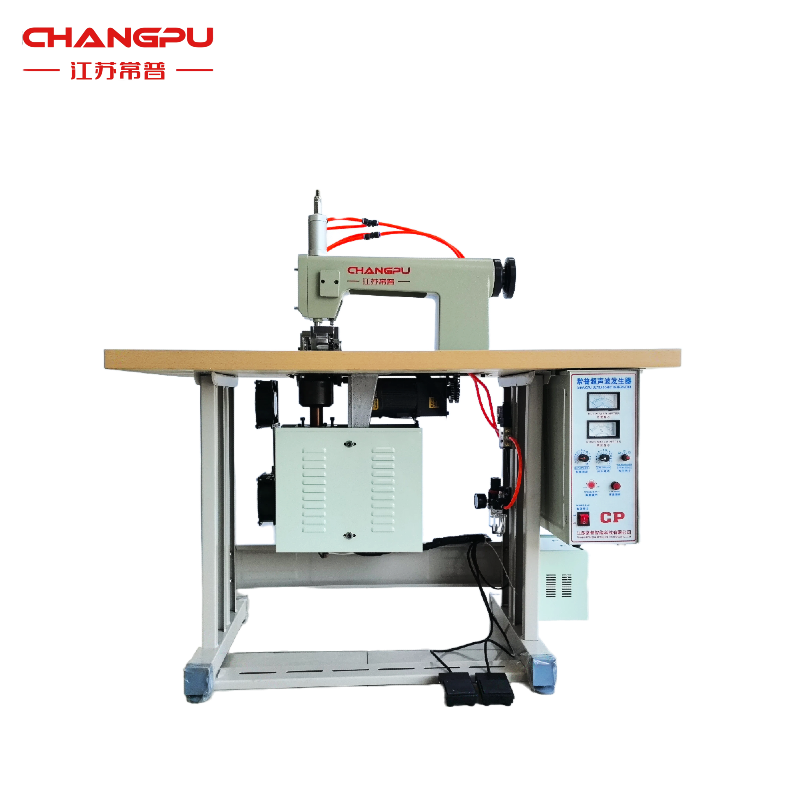
Applications Where Ultrasonic Sewing Excels
The characteristics of ultrasonic sewing make it particularly well-suited to specific product categories:
Underwear and Lingerie — The Changpu ultrasonic sewing machine vs traditional sewing comparison is most decisive in underwear manufacturing. Elastic band attachment, lace trim bonding, side seam joining, and label attachment can all be performed ultrasonically. The soft, flat seams are more comfortable than stitched seams, eliminating the irritation that stitching can cause in sensitive areas. The speed advantage reduces production cost, and the elimination of thread inventory simplifies material management. Changpu's CP-60S ultrasonic underwear machine is specifically engineered for this application, with dual-motor speed regulation and a 20 kHz computer-controlled generator.
Surgical Gowns and Medical Textiles — Fluid barrier integrity is a critical performance requirement for surgical gowns. Stitched seams create thousands of perforations that compromise barrier performance — even with seam sealing tape applied afterward. Ultrasonic seams create no perforations, maintaining the gown's barrier properties at every seam. Changpu's radial ultrasonic lace machine is designed specifically for surgical gown assembly, with pneumatic mold control for consistent pressure across the seam length.
Non-Woven Disposable Products — Disposable underwear, bouffant caps, shoe covers, and isolation gowns are manufactured from non-woven polypropylene or similar thermoplastic materials — ideal candidates for ultrasonic assembly. The high-speed, continuous operation of ultrasonic machines matches the volume requirements of disposable product manufacturing, and the elimination of thread cost is particularly significant for low-margin disposable products where every fraction of a cent in production cost matters.
Non-Woven Bags — Shopping bags, promotional bags, and packaging bags made from non-woven polypropylene are assembled ultrasonically. The ultrasonic seam is stronger than a stitched seam in non-woven material because the bond area is larger than the point-contact of a stitch, distributing stress more effectively. Changpu manufactures manual and semi-automatic ultrasonic non-woven bag machines for this application.
Decorative and Functional Bonding — Lace and trim attachment, label bonding, pocket attachment, and patch application can all be performed ultrasonically. The bond is invisible from the face side, avoiding visible stitching on decorative elements. The process is faster than stitching and requires no thread color matching.
When Traditional Sewing Remains the Right Choice
Ultrasonic sewing is not a universal replacement for traditional methods. Traditional sewing remains the appropriate choice when:
The material is natural fiber without sufficient thermoplastic content — 100% cotton garments, wool products, silk items
The seam must be visually indistinguishable from a stitched seam for aesthetic or brand reasons — some premium apparel markets associate stitching with quality
The production environment is already fully equipped with traditional sewing machines and the volume does not justify the capital investment in ultrasonic equipment
The product requires seam rippability — a stitched seam can be unpicked for alterations; an ultrasonic seam is permanent
The production volume is too low to justify the throughput advantage of ultrasonic equipment