

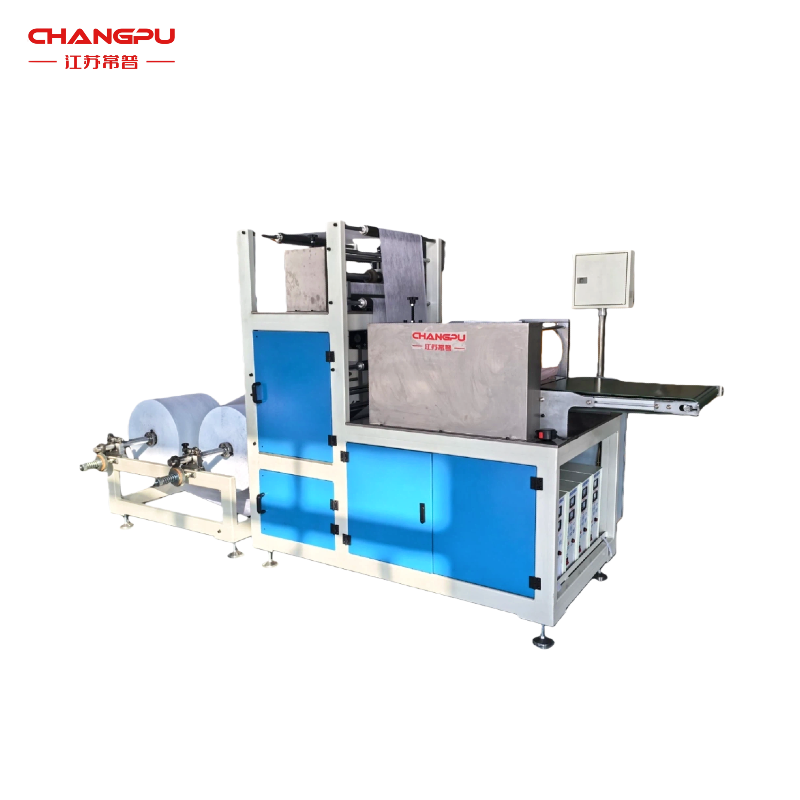
The Three Technologies Being Displaced
To understand why ultrasonic technology is winning, it is necessary to understand the three traditional methods it is replacing:
Mechanical Sewing (Needle and Thread) — The oldest method and still the most widely used globally. Thread passes through fabric layers to create a mechanical lockstitch. The method works with any fabric type but creates perforations, consumes thread as a recurring cost, and is limited in speed by the mechanical cycle of the needle assembly.
Hot-Melt Adhesive Bonding — A thermal method in which molten adhesive is applied between material layers, then cooled to create a bond. Widely used in diaper and sanitary pad manufacturing. The method creates strong bonds but requires adhesive as a consumable, involves heated systems with warm-up time and temperature control complexity, and introduces a foreign material (adhesive) into the product.
Thermal Calender Bonding — Material layers pass between heated rollers that melt and fuse thermoplastic fibers at the contact points. Used for laminating non-woven composites. The method is effective but energy-intensive (the entire roller mass must be heated) and creates a stiffer product than ultrasonic bonding because the heat affects a broader area than just the bond points.
Ultrasonic technology displaces each of these methods in different application domains, as the following sections detail.
Domain 1: Replacing Mechanical Sewing
The displacement of mechanical sewing by ultrasonic bonding is most advanced in non-woven product manufacturing and is progressing rapidly in textile applications where the material contains sufficient thermoplastic content.
The reasons ultrasonic bonding dominates production equipment in this domain are compelling and cumulative:
Speed — An ultrasonic bonding station operates at the speed the material can be fed through it — there is no mechanical cycle limiting throughput. Changpu's ultrasonic sewing machines operate at line speeds of 10-50 meters per minute depending on material, compared to 5-15 meters per minute for industrial lockstitch machines at typical stitch densities. The throughput advantage is typically 2-3x.
Thread Elimination — Thread is a recurring consumable cost that never goes away. For a factory producing 10,000 surgical gowns per day at 150 meters of thread per gown, annual thread consumption is approximately 550,000 kilometers — enough to wrap the Earth 13 times. The cost of this thread, plus the operational overhead of inventory management, color matching, and breakage-related downtime, is eliminated by ultrasonic bonding. Over a machine's 5-year service life, thread savings alone can exceed the machine's purchase price.
Needle Hole Elimination — Every stitch point is a perforation. For products requiring barrier properties — surgical gowns, waterproof garments, down-filled jackets — these perforations are functional defects that must be mitigated through additional processing (seam taping) or accepted as performance limitations. Ultrasonic bonding creates no perforations, preserving the material's barrier properties.
Seam Quality — Ultrasonic seams are flat, soft, and uniform. There is no raised stitch line on top, no looping bobbin thread underneath, and no thread tension variation causing puckering or gathering. For next-to-skin products, this translates to comfort. For technical products, it translates to consistent performance.
Domain 2: Replacing Hot-Melt Adhesive Bonding
In the hygiene products industry — sanitary pads, diapers, adult incontinence products — ultrasonic bonding is increasingly challenging the dominance of hot-melt adhesive systems. The Changpu ultrasonic technology replacing traditional non-woven manufacturing methods is particularly evident in this segment.
Adhesive Cost Elimination — Hot-melt adhesive is a significant operational expense. A single diaper production line running at 500 diapers per minute can consume USD 200,000-400,000 in adhesive annually, depending on diaper design and adhesive application patterns. Ultrasonic bonding eliminates this cost entirely.
System Simplification — Hot-melt systems are complex subsystems within a production line: adhesive storage and melting units, heated hoses, application nozzles, temperature controllers, and pattern controls. Each of these components requires maintenance and can fail. Ultrasonic systems are self-contained — generator, transducer, booster, horn — with no heated plumbing, no nozzle clogging, and no adhesive handling.
Startup Speed — Hot-melt systems require warm-up time — typically 15-30 minutes — before the adhesive reaches application temperature and viscosity. Production cannot begin until the system is ready. Ultrasonic systems are ready to operate within seconds of power-on. For production lines that stop and start frequently — for shift changes, material changes, or maintenance — this difference accumulates into significant lost production time.
Product Feel — Adhesive adds stiffness to a product. The adhesive layer, even when applied in thin patterns, changes the hand feel of the material. Ultrasonic bonding creates no additional stiffness because there is no foreign material between the bonded layers. For products where softness is a consumer preference driver — sanitary pads, baby diapers — this difference is commercially significant.
Domain 3: Replacing Thermal Calender Bonding
In non-woven fabric lamination — bonding multiple layers of non-woven into a composite material — ultrasonic bonding is beginning to compete with traditional thermal calender bonding.
Energy Efficiency — Thermal calenders heat large steel rollers to temperatures of 130-180°C, consuming significant energy to maintain the roller mass at bonding temperature continuously. Ultrasonic bonding generates heat only at the bond points, only at the moment of bonding — the energy is applied precisely where and when it is needed. Energy consumption is typically 50-70% lower than equivalent thermal calender systems.
Product Quality — Thermal calender bonding subjects the entire material web to elevated temperature and pressure as it passes between the rollers. This can cause unintended fiber melting, material thinning, and stiffness beyond the bond points. Ultrasonic bonding affects only the bond area, leaving surrounding material at ambient temperature and preserving its original properties.
Pattern Flexibility — Changing the bond pattern on a thermal calender requires changing the engraved roller — a heavy, expensive component that requires equipment downtime for changeover. Ultrasonic pattern changes can be achieved through parameter adjustments for some patterns, or relatively quick horn changes for others. The flexibility advantage is significant for manufacturers producing multiple products on the same line.
The Sustainability Dimension
A factor accelerating the adoption of ultrasonic technology in all three domains is sustainability. The Jiangsu Changpu non-woven ultrasonic machinery factory future is closely tied to the growing importance of environmental performance in manufacturing equipment decisions.
Mono-Material Product Design: Ultrasonic bonding enables products made from a single polymer type because it welds the material to itself rather than introducing a foreign bonding agent. A non-woven product made entirely of polypropylene and bonded ultrasonically can, in principle, be recycled as a single polymer stream. A product that introduces hot-melt adhesive (typically EVA or rubber-based) or cotton thread into a polypropylene structure creates a mixed-material waste stream that is difficult or impossible to recycle economically.
Energy Efficiency: The point-energy nature of ultrasonic bonding — applying energy only where and when needed — is inherently more efficient than systems that heat large masses (thermal calenders) or maintain molten material at temperature continuously (hot-melt systems). As energy costs rise and carbon accounting becomes more prevalent in supply chain management, this efficiency advantage becomes a procurement criterion.
Waste Reduction: Ultrasonic bonding's precise, controlled energy delivery reduces production waste. Less material is damaged by excessive heat. Fewer products are rejected for bond quality issues. Less scrap is generated during startup and shutdown. These reductions, while small in percentage terms, accumulate to significant absolute volumes in high-throughput production environments.
The Remaining Barriers to Adoption
While ultrasonic technology is clearly on a trajectory to become the dominant bonding method in non-woven manufacturing, barriers to full adoption remain:
Material Limitations: Ultrasonic bonding requires thermoplastic content in the material — typically 50% or more. Pure natural fiber products (100% cotton, 100% wool) cannot be ultrasonically bonded. This limits the technology's applicability in premium apparel and certain textile segments that use natural fibers.
Capital Cost: Ultrasonic equipment carries a higher initial purchase price than equivalent mechanical sewing machines. The payback comes from consumable savings and throughput advantages, but the higher upfront cost can be a barrier for manufacturers with limited capital or short investment horizons.
Knowledge and Skill Gap: Many production managers and machine operators have decades of experience with mechanical sewing or hot-melt systems and limited exposure to ultrasonic technology. Transitioning requires training investment and a willingness to learn parameter-based process control rather than mechanical adjustment.
Perception in Some Markets: In certain apparel markets, visible stitching is associated with quality and craftsmanship. Products without visible stitching can be perceived as lower quality by consumers unfamiliar with ultrasonic bonding. This perception barrier will erode over time as ultrasonic products become more common.