

Understanding the Two Cutting Technologies
Cold Knife Cutting uses a sharp, unheated blade to mechanically sever the material through shear force. The blade edge is ground to a precise angle optimized for clean cutting of the target material. Because the blade is not heated, there is no thermal effect on the material — no melting, no edge hardening, no discoloration. The cut quality depends on blade sharpness, blade speed, material tension, and the mechanical properties of the material being cut.
Hot Knife Cutting uses an electrically heated blade that both cuts and seals the material edge simultaneously. The blade temperature is adjustable, typically in the range of 100°C to 500°C depending on the material. When the hot blade passes through thermoplastic material, it melts the fibers at the cut line, creating a sealed edge that resists fraying. The cut quality depends on blade temperature, blade speed, material thickness, and the melting characteristics of the material.
The fundamental difference: cold knife cutting is a purely mechanical process that severs material by force; hot knife cutting is a thermal-mechanical process that severs and seals material by melting.

Material-by-Material Selection Guide
The choice between cold knife and hot knife is primarily driven by the material being cut, the desired edge quality, and the downstream processing requirements.
Elastic Tape and Elastic Webbing — Recommendation: Cold Knife. Elastic materials stretch under tension. A hot knife adds thermal softening to the already-challenging behavior of elastic under tension, which can result in inconsistent cut lengths as the material stretches and contracts unpredictably in the heat-affected zone. Cold knife cutting maintains dimensional accuracy by avoiding thermal effects. Changpu's cold knife machines achieve length accuracy of ±0.5 mm on elastic tape when properly tensioned.
Nylon Webbing and Polyester Webbing — Recommendation: Hot Knife. Both nylon and polyester webbing fray aggressively when cut cold — individual fibers separate from the cut edge, creating a ragged appearance and weakening the webbing end. Hot knife cutting simultaneously cuts and seals the edge, fusing the fiber ends into a clean, fray-resistant termination. This is essential for webbing used in bag straps, pet collars, safety harnesses, and outdoor equipment where edge fraying would be unacceptable.
Hook-and-Loop Fastener (Velcro) — Recommendation: Cold Knife. Hook-and-loop material has a complex surface structure — tiny hooks on one side, loops on the other — that would be damaged by hot knife contact. The heat would melt and flatten the hook structures, destroying their fastening function in the heat-affected zone. Cold knife cutting preserves the surface structure and delivers clean, functional edges. Changpu's machines are programmed to handle the asymmetric thickness of hook-and-loop material without jamming.
Polyester and Nylon Labels — Recommendation: Hot Knife. Woven labels, printed labels, and care instruction labels benefit from hot knife cutting because the sealed edge prevents fraying during garment washing and wear. A frayed label on a finished garment is a quality defect that can lead to customer returns — hot knife cutting prevents it at the source.
Cotton and Natural Fiber Ribbons — Recommendation: Cold Knife. Natural fibers do not melt, so hot knife cutting provides no sealing benefit and can scorch or discolor the material. Cold knife cutting delivers clean, unburned edges on cotton, linen, and other natural fiber ribbons and tapes.
Polypropylene and Polyethylene Rope — Recommendation: Hot Knife. Synthetic ropes fray aggressively when cut cold, and the frayed end makes threading through eyelets, pulleys, or cord locks difficult. Hot knife cutting seals the rope end into a clean, tapered tip that is easy to handle and thread. Changpu's rope cutting machines are configured with hot knife cutting as standard.
Non-Woven Fabric Strips — Recommendation: Hot Knife. Non-woven materials have no woven structure to resist fraying — individual fibers separate easily from a cold-cut edge. Hot knife cutting fuses the edge fibers together, creating a clean, stable edge that will not shed fibers during handling and subsequent processing.
The Jiangsu Changpu Computerized Cutting Machine Line
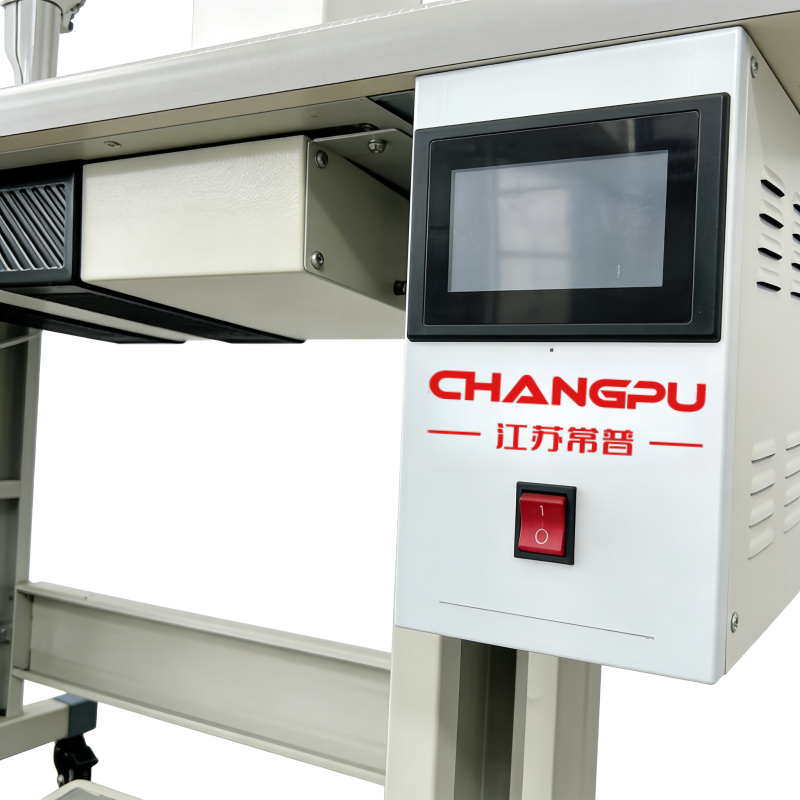
As a Jiangsu Changpu computerized cutting machine supplier, the company offers cutting machines configured for both cold knife and hot knife operation, with several models supporting rapid changeover between the two methods. Key features across the product line include:
1,200 RPM Operating Speed — Changpu cutting machines operate at up to 1,200 revolutions per minute, translating to high throughput for production environments that process thousands of cuts per shift. The actual cutting rate depends on material feed length — shorter cuts achieve higher pieces-per-minute output because the feed cycle is shorter.
Computerized Length Control — Cut length is programmed through the touchscreen HMI in millimeters or inches. Length accuracy is maintained by a servo-driven feed system with encoder feedback, eliminating the mechanical length-setting mechanisms that drift over time on manual and semi-automatic machines. Multiple cut lengths can be stored as recipes for quick changeover between different products.
Multi-Material Compatibility — A single Changpu cutting machine can process elastic tape at one width, webbing at another, and ribbon at another — with recipe recall handling the length, speed, and cutting method (hot or cold) for each material. This flexibility is valuable for contract manufacturers and factories producing multiple product types.
Automatic Feeding and Collection — Material is fed automatically from rolls or spools, with tension control to maintain consistent feed without stretching. Cut pieces are collected in a bin, on a conveyor, or stacked — depending on the machine configuration — reducing the manual handling that slows down semi-automatic systems.
Jam Detection and Auto-Stop — Sensors detect material jams, end-of-roll conditions, and blade faults, automatically stopping the machine to prevent damage and material waste. This feature is particularly valuable in unattended or lightly attended operation.
Pricing — Changpu computerized cutting machines are priced from USD 500 to USD 2,000, making them accessible as entry-level equipment for buyers evaluating Changpu as a supplier. The wide price range reflects configuration options — cold knife only, hot knife only, or dual capability; cutting width capacity; and automation features.
Operational Considerations
Beyond the cold knife vs hot knife decision, several operational factors affect cutting machine performance:
Blade Maintenance — Cold knife blades dull with use and require periodic sharpening or replacement. The blade life depends on the material being cut — abrasive materials like fiberglass-backed tape will dull blades faster than soft cotton ribbon. Changpu provides blade sharpening guidance and stocks replacement blades for all models. Hot knife blades also experience wear but at a slower rate because the thermal cutting action is less mechanically demanding than cold shearing.
Material Tension Control — Consistent material tension during feeding is critical for length accuracy. If the material is stretched during feeding, it will contract after cutting, resulting in short pieces. If the material is fed with insufficient tension, it may wander or bunch, causing length variation or jams. Changpu's feed systems include adjustable tension control to accommodate different material stretch characteristics.
Heat Management (Hot Knife) — Hot knife operation generates heat in the blade assembly and surrounding machine components. Changpu machines include thermal management features — insulated blade holders, cooling fans, and thermal cutoffs — to prevent heat buildup from affecting machine performance or operator safety. The blade temperature controller maintains the set temperature within a narrow band, preventing the temperature drift that causes inconsistent edge sealing.
Dust and Debris Management — Cutting operations generate material dust and debris — especially cold knife cutting of brittle materials and hot knife cutting that produces melted edge residue. Changpu machines include debris collection trays and accessible cleaning points. Regular cleaning extends machine life and maintains cut quality.
How to Select the Right Cutting Machine
For B2B buyers evaluating the Changpu ultrasonic cutting machine cold knife hot knife comparison in the context of their specific production needs, the selection process should follow these steps:
Conclusion
The choice between cold knife and hot knife cutting is fundamentally about matching the technology to the material. Cold knife cutting delivers the dimensional accuracy needed for elastic materials and preserves the surface structure of hook-and-loop fasteners and natural fiber ribbons. Hot knife cutting provides the edge sealing essential for fray-prone synthetic webbing, labels, ropes, and non-woven strips.
Changpu's automatic tape cutting equipment manufacturer China factory offers both technologies on a single machine platform with computerized length control, recipe storage, and automatic feeding — enabling manufacturers to cut a wide range of materials with a single equipment investment. At a price point of USD 500 to USD 2,000, these machines serve as accessible entry points into the Changpu product ecosystem, allowing B2B buyers to evaluate the company's quality and service with a modest initial order before progressing to larger capital equipment purchases.