

The medical textile industry operates under some of the most demanding quality requirements in all of manufacturing. Surgical gowns must provide reliable fluid barrier protection while remaining comfortable for surgeons who may wear them for hours at a time. Every seam, every stitch point, every material interface represents a potential failure point — and in a surgical setting, failure is not an option.
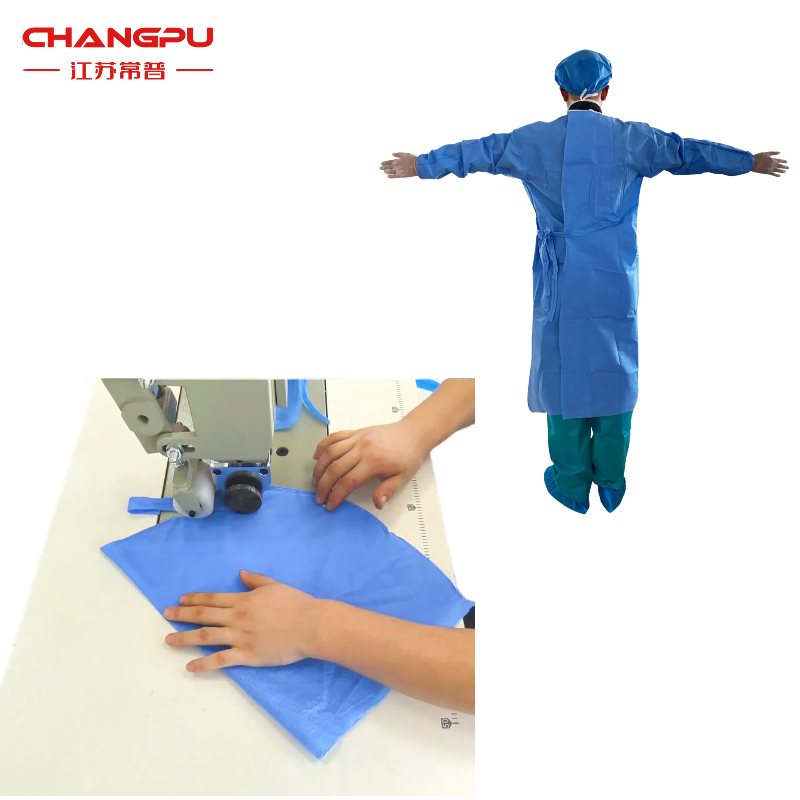
This case study examines how a medical textile manufacturer in Southeast Asia deployed Jiangsu Changpu Intelligent Technology's radial ultrasonic lace machine to transform their surgical gown production line. The results — in throughput, quality, and operating cost — illustrate why the Changpu ultrasonic surgical gown sewing machine case study model is being replicated by medical textile manufacturers worldwide.
The Production Challenge
The manufacturer, a mid-scale producer of surgical gowns, isolation gowns, and medical drapes based in Vietnam, faced three interconnected production challenges that were limiting growth and compromising margins.
Challenge 1: Seam Quality and Barrier Integrity — The manufacturer's traditional sewing machines created stitched seams on surgical gowns that required post-seam sealing tape application to achieve the fluid barrier performance required by international standards (AAMI PB70, EN 13795). The seam taping process added a separate production step, consumed expensive sealing tape, and created a quality inspection bottleneck — every taped seam had to be visually inspected, and tape adhesion failures were the most common quality defect. Despite this additional process and cost, barrier integrity testing occasionally showed leakage at stitch holes where the tape had not fully adhered or had developed micro-channels during sterilization.
Challenge 2: Thread Cost and Downtime — The manufacturer operated 40 traditional industrial sewing machines across two shifts for gown production. Thread consumption was approximately 150 meters per gown for all seams. At a daily production volume of 2,000 gowns, the factory consumed 300 kilometers of thread per day. Thread purchasing, inventory management, and color matching represented a significant operational overhead. Thread breakage — an inherent occurrence in high-speed sewing — caused an average of 12 unplanned stoppages per machine per shift, each requiring operator intervention to re-thread and restart.
Challenge 3: Production Throughput Ceiling — The manufacturer's order book was growing faster than production capacity. Customers — primarily hospital groups and medical distributors — were requesting larger volumes and shorter delivery times. Adding more sewing machines and operators was the conventional solution, but the factory floor was already at capacity, and skilled sewing machine operators were difficult to recruit and retain in the local labor market.
The Changpu Solution: Radial Ultrasonic Lace Machine
After researching alternative production technologies, the manufacturer's engineering team identified ultrasonic sewing as a potential solution to all three challenges. They evaluated multiple suppliers and selected Changpu's radial ultrasonic lace machine based on three factors: the machine's specific design for surgical gown assembly, Changpu's CE certification (important for the manufacturer's export customers who required EU-compliant production equipment), and Changpu's willingness to provide material samples testing with the manufacturer's actual gown materials before the purchase decision.
The radial ultrasonic lace machine deployed was configured with:
28 kHz operating frequency — optimized for the SMS (Spunbond-Meltblown-Spunbond) non-woven material used in the manufacturer's Level 3 and Level 4 surgical gowns
Pneumatic mold lifting — ensuring consistent pressure distribution across the full length of each seam, critical for uniform bond strength
Dual-motor speed regulation — enabling independent control of material feed speed and ultrasonic bonding rate
Changpu CP-60S ultrasonic generator — with computer-controlled frequency tracking and amplitude regulation
The machine replaced the entire seam creation process — stitching plus taping — with a single ultrasonic bonding operation. Material layers were fed through the machine at a continuous rate, with the radial horn applying 28 kHz vibration to bond the SMS layers together along the seam line. No thread, no tape, no post-processing.
Scalability and Replication
Based on the success of the initial deployment, the manufacturer placed an order for additional Changpu ultrasonic lace machines to convert their remaining surgical gown production lines. The scalability of the medical gown production line ultrasonic equipment supplier solution — both within a single factory and across multiple facilities — was validated by the consistency of results across machines.
For other medical textile manufacturers considering a similar transition, the key success factors identified from this case study include:
Conduct material compatibility testing with your specific gown materials before making a purchase decision — ultrasonic bonding performance varies with material composition and GSM weight
Plan the production line reconfiguration to optimize material flow around the new ultrasonic workstations
Train operators on parameter-based process control — the skill set is different from mechanical sewing machine operation
Establish ultrasonic horn inspection and replacement schedules as part of the preventive maintenance program
Conclusion
This Changpu ultrasonic surgical gown sewing machine case study demonstrates that ultrasonic sewing technology delivers measurable improvements across the three dimensions that matter most to medical textile manufacturers: throughput, quality, and cost. The manufacturer eliminated thread and tape consumables worth USD 285,000 annually, increased per-machine output by 168%, improved barrier integrity test results, and freed floor space and labor for expanded production.
For medical textile manufacturers facing the same challenges — thread cost, seam quality, and throughput constraints — Changpu's radial ultrasonic lace machine represents a proven Jiangsu Changpu medical textile machinery manufacturing solution that has been validated in production environments and delivers results that justify the investment decisively.